
120,000 tonnes a year.
Nothing leaves as waste.
Somanya is not a factory with a few add-ons. It is one integrated capability stack — intake to container, molecule to market, kilowatt to cubic metre — engineered so every tonne of tropical fruit finds its highest possible value before anything is allowed to leave the campus.
End-to-End Processing
Gate to container in one campus — grading, aseptic, HPP, drying, extraction, packing and export documentation.
Bio-Refinery
Every fraction of the fruit is routed to its highest-value molecular destination instead of a single juice line.
Energy Optimisation
Solar, biogas CHP and a battery buffer carry the base load; the grid only ever firms the balance.
Water Stewardship
Counter-current washing, condensate recovery and a constructed wetland make the campus a water producer.
Science Capability
Four accredited units — analytics, bioprocess, agronomy and sensory — turning research into saleable specification.
Global Ingredients
Compliance-cleared ingredient supply into the EU, UK, GCC, North America, Asia and the AfCFTA region.
Circularity
Six closed loops return peel, kernel, residue, digestate, water and heat back into product or process.
Renewables maximised, battery dispatched hard.
Set the intake.
See the whole campus respond.
Move the tonnage, uptime and shift pattern and every processing train re-plans itself — line utilisation, finished output, energy demand, water draw and the constraint that will bind first.
7,366 productive hours across 330 operating days. Constraint line: Aseptic Puree & Concentrate at 56% of design.
Seven value trains
from one fruit.
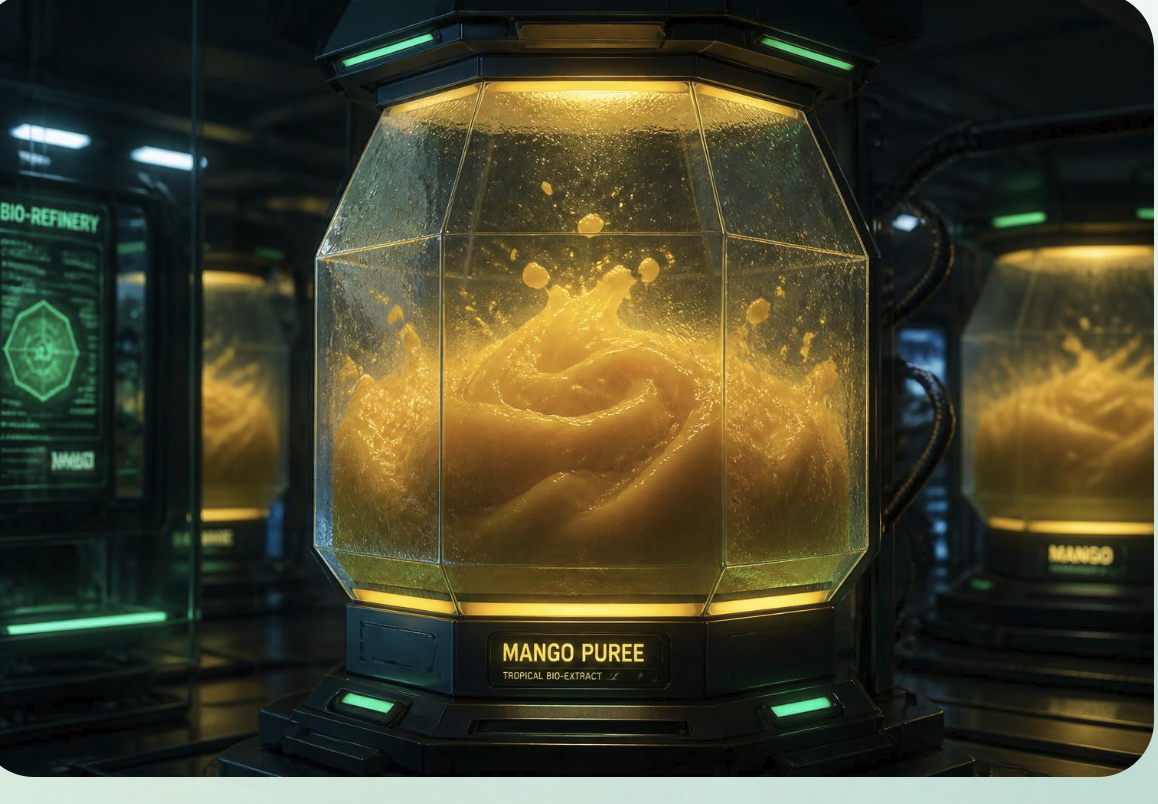
Peel, pulp, core, kernel and pomace are separated at the molecular gate and routed to their highest-value destination — aseptic puree, HPP juice, freeze-dried actives, kernel butter and pharmaceutical-grade enzymes.
Seven Trains
One fruit · no orphan fractions

Six megawatts and a closed water loop
Biogas digesters · solar field · reclaim clarifiers
Closed water loop · 98% process water recycled
Six megawatts
on a renewable spine.
Solar, biogas CHP and a battery buffer carry the base load; the grid only ever firms the balance. Dial the demand and dispatch and watch self-sufficiency, cost and Scope 2 all move together.
- Blended cost
- $62/MWh
- Annual energy spend
- $1.9M
- Scope 2 footprint
- 1,361 tCO₂e
- Exported to grid
- 0.0 GWh
8.4 ha bifacial array over the intake yard and staff parking, tracking on a single axis.
Anaerobic digesters fed on process residue; waste heat feeds the aseptic and drying trains.
6 MWh lithium buffer that shifts the solar peak into the night-shift extraction window.
Firming contract with the national utility — the balancing source, not the base load.

Biogas domes and a four-megawatt solar field
CHP base load · battery buffer · grid firming only
Renewable spine · biogas CHP and solar
Fruit is 85% water.
So the campus makes its own.
Counter-current washing, closed CIP recovery, evaporator condensate polishing and a four-hectare constructed wetland turn a heavy water user into a net water producer for the Somanya catchment.
Fruit Wash & Flume
Ozonated counter-current wash — the last rinse is always the cleanest water in the chain.
CIP & Sanitation
Closed CIP skids recover caustic and final-rinse water for the next pre-rinse cycle.
Evaporator Condensate
Fruit is 85% water. Concentration recovers it as clean condensate — the campus makes water.
Extraction & Membranes
RO and nanofiltration permeate is cascaded down to wash duty rather than discharged.
Constructed Wetland
A 4 ha reed-bed polishes the balance to irrigation grade for the nursery and demonstration block.
Eighty-five scientists.
Four accredited units.
Analytics, bioprocess, agronomy and sensory work as one pipeline — a molecule discovered in the pilot hall becomes an accredited assay, a field trial and a saleable specification without leaving the campus.
Molecular Analytics Lab
ISO/IEC 17025Six trade blocs.
One compliance spine.
Every ingredient leaves with the documentation its destination demands — EU Organic and EUDR, BRCGS for the UK, Halal for the Gulf, FSVP and cGMP for North America, pharmacopeia dossiers for Asia and origin certificates for AfCFTA.
European Union
Dairy, infant nutrition, beverage majors
United Kingdom
Retail own-label, smoothie brands
GCC & Middle East
Beverage bottlers, hospitality supply
North America
Nutraceutical formulators, foodservice
East & South Asia
Pharma actives, premium retail
AfCFTA Region
Regional processors, school nutrition
Six closed loops.
Zero to landfill.
Peel becomes packaging, kernel becomes cosmetics, residue becomes power, digestate becomes soil, condensate becomes process water and waste heat becomes drying capacity. Circularity here is a margin strategy, not a slogan.
Every tonne, routed to its highest molecular destination.
One integrated capability stack turns 120,000 tonnes of tropical fruit into aseptic puree, HPP juice, freeze-dried actives, kernel butter, enzymes, biogas, packaging, fertiliser and power — before anything leaves the gate.